Six months and I've scarcely learned any Amharic beyond simple
pleasantries. Fair, it's a tough language and I work almost entirely with
English speakers, so if I can order food and a couple of beers then I'm getting
along alright ("hulet biya afellegalu"). Surprisingly, in between
occasional games of Petanque and some cheap classes, I've improved my French a
great deal more. At least they speak it in more than one country, he said,
trying not to sound disdainful.
Typical of a lapsed fat kid, I have learned quite a lot about food and
some of the most enjoyable food you can find in Dire Dawa is on the street.
It's a mix of traditional Ethiopian, middle-eastern, and one dish which seems
to be cobbled together simply to get the best taste from the cheapest ingredients.
My phrasing belies the fact that this - enkulal ba dinich/አንኩላል ባ ድኒች - tastes
incredible.
 |
| Enkulal ba dinich |
Literally 'eggs with potato', this slightly odd combination of eggs, potato, lentils, kidney beans, chillies, onions, a little oil and lime juice is really delicious. Served with crusty bread and sweet spiced tea, you'll damn well have your carbs on board for 10 birr/$0.50 for a big plate of it.
It's pretty humble stuff, but these little street-stalls provide a nice
place for locals to catch up and relax as they come back to life in the
evenings, having sweltered through another 37-degree afternoon. Something about
eating the way locals do adds to the self-congratulatory sense of authenticity.
You may be able to get a really nice steak with vegetables for $3.50, but
sitting in an air-conditioned hotel does sometimes feel a little hollow. The
air conditioning helps, obviously, but on the street you'll quickly forget
about the heat which in the evenings is generally quite pleasant. It's hard to
reconcile the weirdly artificial feeling of sitting in an air-conditioned lobby
eating steak when just outside the gates are children barefoot in rags living
on the street, where often the closest thing they have to parents is the older
girls who maintain some kind of order.
 |
|
The street stalls in Legahare, part of the Muslim
district, are compelling and a great place to people watch. It's not only
in the architecture that you realise that Islam is one of the main cultural
bridges that brings such a vast diversity to east Africa. The architecture is a
mix of French, Turkish, standard East African and Yemeni Arab. With just a
short while here you'll be able to pick out several distinct languages spoken
simultaneously, often within the same conversation - Amharic with it's distinct ejectives, Somali and Arabic with the deep
glottals, the lively rhythm of Oromifa* and the solitary French phrase often
yelled at white folks; "Bonjour! Ca-va?".
Part of it could be down to the nearby city of Harar. Supposedly the
fourth holiest city in Islam, it once formed the centre of a powerful regional
kingdom in it's own right, and still draws Muslim pilgrims and tourists of all
kinds into the region. It's basically the only thing worth seeing for miles
around, but very much worth seeing.
 |
| Baklava/Baqlawa. |
The middle-eastern influence abounds in the excellent Baklava they serve here. It's like a dessert lasagne of sorts - layers upon layers of filo pastry stuffed with crumbled peanuts and pistachios, soaked in syrup or honey. All down the Muslim district, shops like al-Hashimi sweets ply Baklava, plum cakes and excellent dates, much to the delight of the city's few dentists. I brush at least twice a day, I've heard what the dentists are like.
 |
| Fuul |
A really tasty breakfast for $0.50 has to be fuul, a spicy
bean stew cooked over charcoal. Again, you can find this almost anywhere and
they serve it with surprisingly good soft white bread. They fry boiled fava
bean mush in oil with a lot of berbere, a mix of different hot
spices. When it's done, they top it with chopped chillies and red onion. See it
off with some ludicrously sweet tea and you're well set until lunch. Locals are
often a little taken aback on seeing a westerner eating at such a modest place.
They look as though to ask why you would eat there and not have your cook make
it for you at home, or to eat in the 'fancy' hotel. Well, I don't have a cook
and the hotels leave that hollow feeling whilst charging three times as much,
so that's that.
Not so widely available in Dire Dawa is breakfast fetira. Fried
unleavened bread that crumbles slightly. The fetira guy cooks
it up over a vigorous fire in an old oil drum while you wait. Mix it up with
honey and fresh yoghurt and you aren't going to miss cornflakes too much.
Especially since a box costs nearly $10. Dinner fetira is all
over the place though. At dinnertime they cook it with egg, onions, tomato and
pepper, chopped to bits with a cleaver and in an unexpected move, usually
topped with banana and ketchup. I take the banana separately, thanks.
Suitably enough, considering that Ethiopia is perhaps most famous across
the world for famine and much less so for it's food, is the fact that all of
this is as nothing compared to that which Ethiopia is almost as famous for.
That's the coffee. Buna seems to be what makes Ethiopians tick
and in my six months here so far, I don't think I've once been more than five
minutes from a cup. Again, you can go to the cafes if you want, and be served a
sour, brutally strong attempt at an espresso that leaves black marks on your lips
and fingers, or you can drop by one of the little stalls lining most streets
and be served the smooth coffee typical of Ethiopia. The beans are roasted
fresh throughout the day over charcoal, onto which the buna ladies
sprinkle incense. It's served in a tiny china cup, normally filled half with
sugar before you get it, so if you're not into incredibly sweet coffee, make
sure you say so. The locals around you will be bemused when you ask for
"tinnish sekwar/sekwar yelleu" (a little sugar/no sugar), but the
coffee still tastes great. Again the spirit of authenticity, set and setting,
probably propels this along a bit - often you'll be perched on a little stool
of goat skin stretched across a wooden frame, whilst the air fills with the
warm smell of roasting coffee and the sweet pungency of incense. The fact that
the coffee you're drinking was probably grown not an hour's drive away helps
too.
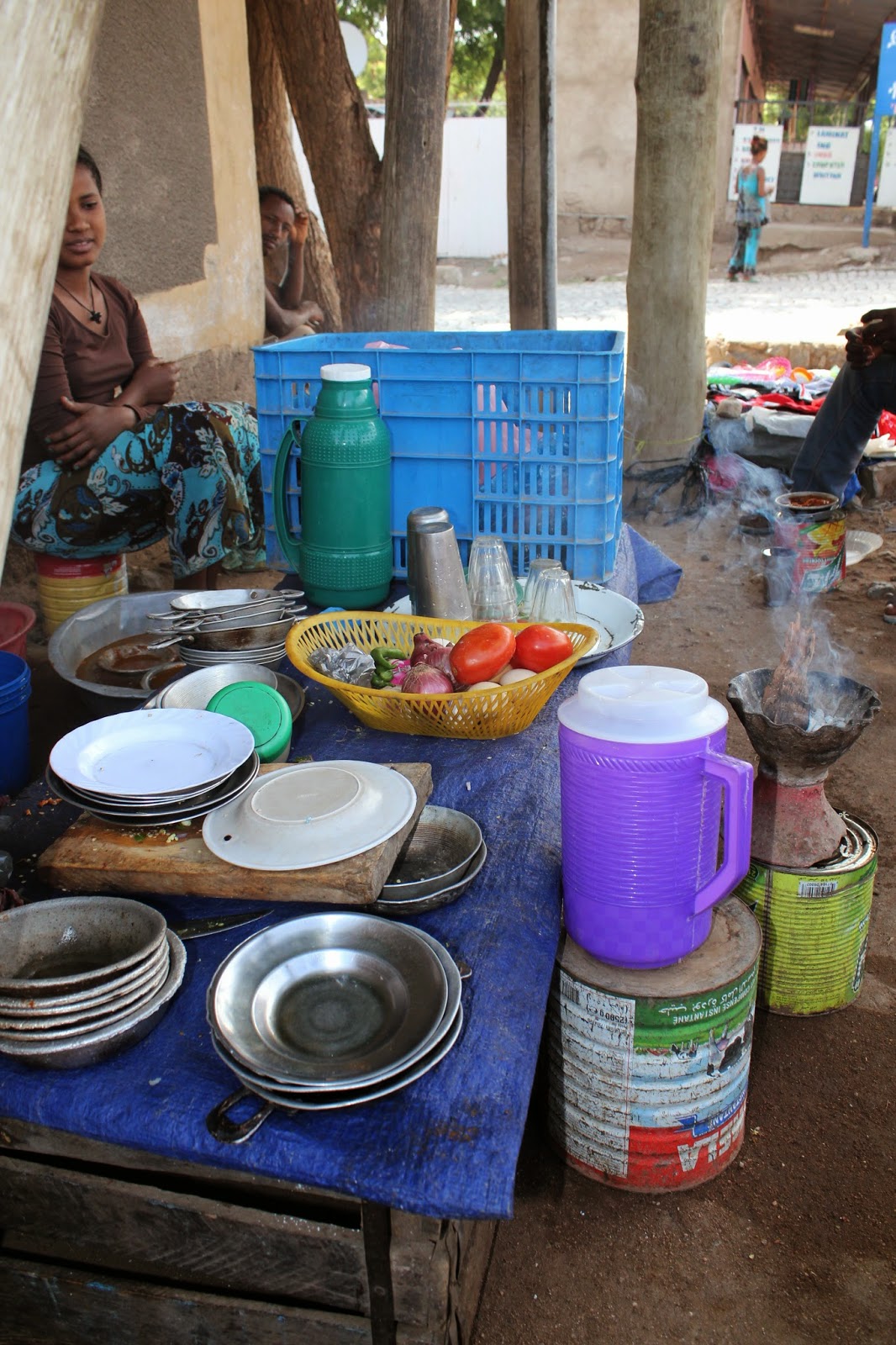 The beans are roasted fresh throughout the day over charcoal, onto which the buna ladies sprinkle incense. It's served in a tiny china cup, normally filed half with sugar before you get it, so if you're not into incredibly sweet coffee, make sure you say so. The locals around you will be bemused, when you ask for "tinnish sekwar/sekwar yelleu" (a little sugar/no sugar), but the coffee still tastes great. Again the spirit of authenticity, set and setting, probably propels this along a bit - often you'll be perched on a little stool of goat skin stretched across a wooden frame. The fact that the coffee you're drinking was probably grown not an hour's drive away helps too.
An honourable mention must go to the samosas. For 1 birr/5 cents, it's a
tasty snack between lunch and dinner, usually filled with lentils or potato and
a fair bit of chilli. You carry them in re-purposed old newspaper, which
considering that I've eaten from Turkish, Georgian, American and British
newspapers, might indicate the regard most Ethiopians have for their press.
This could be down to the government's questionable policies to the media, or
that mere fact that literacy is around 43%. Bombalino, ubiquitous
deep-friend pastry doughnuts are also served for breakfast. They're ok, though
not even a patch on fuul.
The street stalls do, of course, serve injera, dishes based
on the divisive Ethiopian sour pancake. I'll skirt over this because unless
you're here on a very tight budget, you're much better trying injera in
a proper restaurant. It's a weird enough taste and texture for westerners
without skimping and going for the cheap stuff which normally uses lots of
wheat in place of the more expensive teff flour which usually
leaves it drier. I'll cover injera in more depth some other
time.
*Oromifa can often be quite easy to read. The phrase "Rift Valley University" written in Oromifa is "Yooniiversitii Riiftii Vaali"


 Simplified though it may be, to some extent the museum has to manage people's expectations, and most come to this place to look at mummies, sarcophaguses and that kind of thing. I just wish they strove more to challenge people's perceptions rather than to reinforce the simplified way of thinking that leads many to fear or mistrust Africa. Promoting a drastically simplified notion of African-ness encourages this ignorance.


