Showing posts with label africa. Show all posts

Monday, 29 December 2014

Beggars


There are few things more striking that you’ll find when spending any time in Ethiopia than the sheer amount of people living rough on the streets. Back home we have more than any so-called ‘developed’ society should have, but in Ethiopia beggars are notable not only by their numbers but also by their variety. I have almost certainly seen female or elderly homeless people back in the UK, but I can’t remember where or when – at home they are nearly always men. I think and hope that the reason I don’t see elderly homeless people in the UK is because at a certain stage, social care takes over, and, for the time being, there are refuges for women.

People living on the streets here are male and female, from the cradle to the grave – often literally - there are homeless at every stage of life. Many, mostly boys, live their entire lives on the street. By adolescence many show signs of developing mental illness. I have seen no grown men living on the street here who aren’t severely mentally ill or drug dependent. Most are both.

Skeletally thin, these men seem all but lost. They refuse offers of food. When not chewing chat many wander the streets, their clothes hanging off in raged strips of assorted fabric, not faintly aware of being fully exposed.

A man with grotesquely swollen lips indiscriminately eating rubbish from the gutter, laughing. Another sitting stark naked for hours on end in a skip being picked through by dogs and goats. A skeleton wrapped in dark brown skin and rags lying in the gutter at the bus station as commuters jostle past one another, drifting through their morning routine. These things don’t shock me anymore but they’ll never leave me.

People

The label ‘beggars’ reflects in some measure how they are perceived and treated here in Ethiopia and in the UK. I was once admonished by a friend with words to the effect of “he’s just going to spend it on drink” for giving 50p to a man sitting wrapped in a sleeping bag next to an ATM in Belfast. We were just about to go into a club to spend the money on drink ourselves. The man was right there, well within earshot. I doubt my friend knew - in saying this, I doubt he cared.

We use words in this way when we, consciously or not, want to replace or qualify someone’s personhood – their humanity – into a special or different category. Something deviant, other, or entirely alien, and it’s always pejorative.  Loosely, you can do this by turning the adjective describing the person into the noun representing the human – encompassing the whole of their identity. Think:

A gay man           -              A gay.
Of course, like anything in language, like most things really, no rule holds for all cases. Think:

A Pakistani          -              A Paki*.
To call someone ‘a Pakistani’ is to frame them primarily in terms of their nationality, but it isn’t necessarily pejorative. My friend’s attitude wasn’t an aberration. It’s entirely normal and almost everybody does it. It’s an attitude that reflects this ‘othering’ of a marginalised population of people. You’ll never hear this construction of the identity of someone powerful or successful other than in a light-hearted way,  not even when they are being criticised. I can’t even think of a nickname with the slightest chance of sticking to rich people. There probably are some for powerful women.

My point is that in language and in action they are treated like something other or less than human. The logic would seem to be that ‘they are suffering, therefore they deserve to be marginalised’.

Beggars and choosers

Everybody chooses. It just happens that often the choice is between difficult to distinguish bad options. A homeless person might ‘choose’ this life, in that their choice might be between homelessness and, for example; physical or mental abuse, crime, or any of a long list of awful things 
that they find less preferable to homelessness.

Many of East Africa’s homeless people find themselves in this position because their lives have been ruined by clumsy forms of ‘development’. Enclosing common land and creating enormous arable farms benefits those who come to own the land, which is almost always a very small number of people who become incredibly wealthy. When those people who once lived there try to bring their animals onto land that was once free for them to use, cowherds are beaten, imprisoned, given ludicrous fines they couldn’t possibly pay. In desperation, people come to towns where they might find a job. They rarely can. Landing a job as a security guard in an expat compound is about the best many can hope to achieve. In Ethiopia this usually pays about £30 a month, but very few can land regular work. Most hang around car park areas to blag 20 birr (60p) for an hour’s work watching cars.

Maybe some people end up on the streets because their families rejected them for being drunk, addicted, violent. Maybe a lot of them do. Are you going to assess a human being on the basis of a set of media-filtered assumptions?

*I’ve had people say to me, with a completely straight face, that it’s ok to say ‘Paki’ because you can say an ‘Afghan’ or a ‘Tajik’.


Monday, 4 August 2014

A different kind of recycling

Fantastic though The British Museum is, I think there's a reasonable argument for re-naming it "The (Partly) British Museum", given that a fair amount of it is the loot of imperialism. 

Making a bee-line straight for the Africa section, I was slightly shocked, if in no way surprised, to find that the 'Africa' section lumps the entire continent together, as though every cultural meme in the world's second-largest continent was just a variation of an easy to digest African whole. In short, it reproduces the stereotypical way in which Africa has been so often depicted for decades. The approach that leads even well-educated people to talk about this place, containing minimum 1,250 languages, as though it was just one country. I should point out that there are several wings devoted to Egypt.

This leads to a feeling that there's no real narrative holding the exhibits together. The swords are together, the clothes, the hats, the sculptures, all together. They're all grouped aesthetically rather than by culture, so if you want to learn much about history, you aren't going to get a great deal out of it. Judging by the number of cameras everywhere, I'd say the layout works well for those wanting to get as many interesting shots as possible.

Regardless, the exhibit does have a power of it's own. For better or for worse, one of the most eye-catching exhibits draws on one of the strongest African stereotypes, war. The AK-47 in particular. I've been aware of artists and craftsmen melting down old guns to either re-purpose or to send an artistic message - see this excellent blog post from Nico on a project in Liberia.
The body made from sight leaves, beak from bayonets, feathers from recoil springs.
The message, I suppose is one of defiance. That of a form of beauty being born from a machine designed specifically for killing and asserting power over others. It is a brutal kind of beauty, the bird looking rather skeletal. Or maybe it isn't beauty at all, maybe it's a mockery. Whatever it might be, the fact that men and children have likely looked down one of those sight leaves before firing on someone is rather haunting. A dark joke if nothing else but in the west most humour involving Africa is quite dark.


Right at the front, though, is a more stark and surely a more powerful message. The 'Throne of Weapons' is a stand-in for the message delivered by the entire exhibit. Everything played up to simplified stereotypes. It would be disingenuous of me to argue too strongly against these, though. In many cases, African presidents are held up by that massive threat of force, and are de facto presidents for life. 
I suspect that, in a hopeful gesture, they've deliberately made the throne uncomfortable looking, and perhaps slightly unstable. The sad reality is that from north to south, it has for a long time paid well in Africa to rule your people at the barrel of a gun, being in no way specific about any countries.

As an aside, I often wonder whether there is a significant relationship between countries having the word 'Democratic' in their name and being ruled by dictators. Democratic Republic of the Congo, Democratic People's Republic of Korea. Etcetera.

Simplified though it may be, to some extent the museum has to manage people's expectations, and most come to this place to look at mummies, sarcophaguses and that kind of thing. I just wish they strove more to challenge people's perceptions rather than to reinforce the simplified way of thinking that leads many to fear or mistrust Africa. Promoting a drastically simplified notion of African-ness encourages this ignorance.
A subtle appreciation of African cultures isn't going to do a whole lot to solve poverty, other perhaps than to bring more tourists to the place, but it will broaden minds. And Ethiopia has a lot of exceptional things for tourists. A big glass of fresh mango & avocado juice for $1 being a good starting point.

Some more photos from the Africa exhibit. I can't remember what they're of.


Wednesday, 30 July 2014

Food, culture and other stuff

Six months and I've scarcely learned any Amharic beyond simple pleasantries. Fair, it's a tough language and I work almost entirely with English speakers, so if I can order food and a couple of beers then I'm getting along alright ("hulet biya afellegalu"). Surprisingly, in between occasional games of Petanque and some cheap classes, I've improved my French a great deal more. At least they speak it in more than one country, he said, trying not to sound disdainful. 
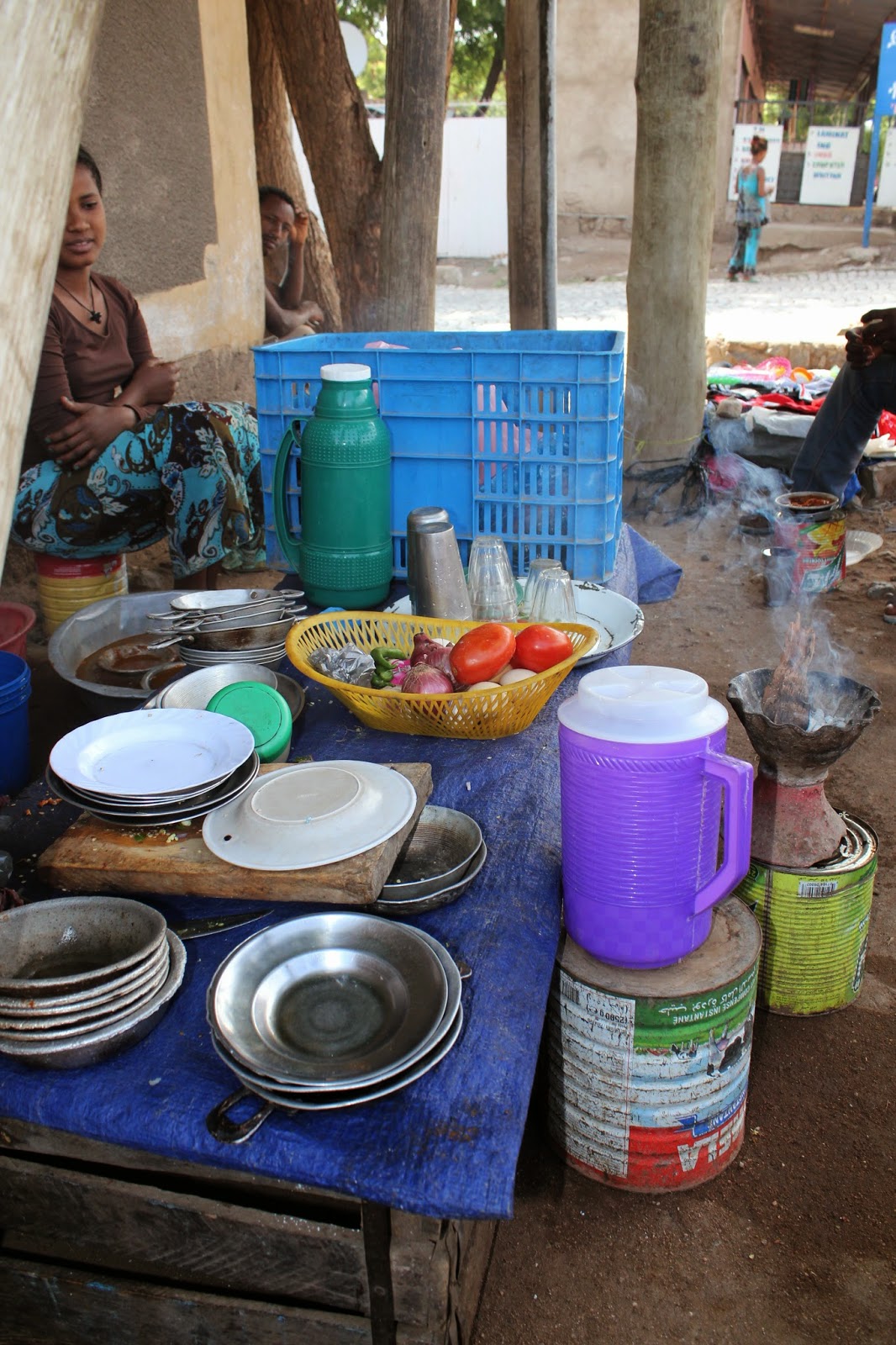
Typical of a lapsed fat kid, I have learned quite a lot about food and some of the most enjoyable food you can find in Dire Dawa is on the street. It's a mix of traditional Ethiopian, middle-eastern, and one dish which seems to be cobbled together simply to get the best taste from the cheapest ingredients. My phrasing belies the fact that this - enkulal ba dinich/አንኩላል ባ  ድኒች  - tastes incredible. 
Enkulal ba dinich

Literally 'eggs with potato', this slightly odd combination of eggs, potato, lentils, kidney beans, chillies, onions, a little oil and lime juice is really delicious. Served with crusty bread and sweet spiced tea, you'll damn well have your carbs on board for 10 birr/$0.50 for a big plate of it.

It's pretty humble stuff, but these little street-stalls provide a nice place for locals to catch up and relax as they come back to life in the evenings, having sweltered through another 37-degree afternoon. Something about eating the way locals do adds to the self-congratulatory sense of authenticity. You may be able to get a really nice steak with vegetables for $3.50, but sitting in an air-conditioned hotel does sometimes feel a little hollow. The air conditioning helps, obviously, but on the street you'll quickly forget about the heat which in the evenings is generally quite pleasant. It's hard to reconcile the weirdly artificial feeling of sitting in an air-conditioned lobby eating steak when just outside the gates are children barefoot in rags living on the street, where often the closest thing they have to parents is the older girls who maintain some kind of order. 


The street stalls in Legahare, part of the Muslim district, are compelling and a great place to people watch. It's not only in the architecture that you realise that Islam is one of the main cultural bridges that brings such a vast diversity to east Africa. The architecture is a mix of French, Turkish, standard East African and Yemeni Arab. With just a short while here you'll be able to pick out several distinct languages spoken simultaneously, often within the same conversation - Amharic with it's distinct ejectives, Somali and Arabic with the deep glottals, the lively rhythm of Oromifa* and the solitary French phrase often yelled at white folks; "Bonjour! Ca-va?".

Part of it could be down to the nearby city of Harar. Supposedly the fourth holiest city in Islam, it once formed the centre of a powerful regional kingdom in it's own right, and still draws Muslim pilgrims and tourists of all kinds into the region. It's basically the only thing worth seeing for miles around, but very much worth seeing. 

Baklava/Baqlawa.
The middle-eastern influence abounds in the excellent Baklava they serve here. It's like a dessert lasagne of sorts - layers upon layers of filo pastry stuffed with crumbled peanuts and pistachios, soaked in syrup or honey. All down the Muslim district, shops like al-Hashimi sweets ply Baklava, plum cakes and excellent dates, much to the delight of the city's few dentists. I brush at least twice a day, I've heard what the dentists are like.

Fuul


A really tasty breakfast for $0.50 has to be fuul, a spicy bean stew cooked over charcoal. Again, you can find this almost anywhere and they serve it with surprisingly good soft white bread. They fry boiled fava bean mush in oil with a lot of berbere, a mix of different hot spices. When it's done, they top it with chopped chillies and red onion. See it off with some ludicrously sweet tea and you're well set until lunch. Locals are often a little taken aback on seeing a westerner eating at such a modest place. They look as though to ask why you would eat there and not have your cook make it for you at home, or to eat in the 'fancy' hotel. Well, I don't have a cook and the hotels leave that hollow feeling whilst charging three times as much, so that's that. 

Not so widely available in Dire Dawa is breakfast fetira. Fried unleavened bread that crumbles slightly. The fetira guy cooks it up over a vigorous fire in an old oil drum while you wait. Mix it up with honey and fresh yoghurt and you aren't going to miss cornflakes too much. Especially since a box costs nearly $10. Dinner fetira is all over the place though. At dinnertime they cook it with egg, onions, tomato and pepper, chopped to bits with a cleaver and in an unexpected move, usually topped with banana and ketchup. I take the banana separately, thanks. 

Suitably enough, considering that Ethiopia is perhaps most famous across the world for famine and much less so for it's food, is the fact that all of this is as nothing compared to that which Ethiopia is almost as famous for. That's the coffee. Buna seems to be what makes Ethiopians tick and in my six months here so far, I don't think I've once been more than five minutes from a cup. Again, you can go to the cafes if you want, and be served a sour, brutally strong attempt at an espresso that leaves black marks on your lips and fingers, or you can drop by one of the little stalls lining most streets and be served the smooth coffee typical of Ethiopia. The beans are roasted fresh throughout the day over charcoal, onto which the buna ladies sprinkle incense. It's served in a tiny china cup, normally filled half with sugar before you get it, so if you're not into incredibly sweet coffee, make sure you say so. The locals around you will be bemused when you ask for "tinnish sekwar/sekwar yelleu" (a little sugar/no sugar), but the coffee still tastes great. Again the spirit of authenticity, set and setting, probably propels this along a bit - often you'll be perched on a little stool of goat skin stretched across a wooden frame, whilst the air fills with the warm smell of roasting coffee and the sweet pungency of incense. The fact that the coffee you're drinking was probably grown not an hour's drive away helps too. 

The beans are roasted fresh throughout the day over charcoal, onto which the buna ladies sprinkle incense. It's served in a tiny china cup, normally filed half with sugar before you get it, so if you're not into incredibly sweet coffee, make sure you say so. The locals around you will be bemused, when you ask for "tinnish sekwar/sekwar yelleu" (a little sugar/no sugar), but the coffee still tastes great. Again the spirit of authenticity, set and setting, probably propels this along a bit - often you'll be perched on a little stool of goat skin stretched across a wooden frame. The fact that the coffee you're drinking was probably grown not an hour's drive away helps too. 

An honourable mention must go to the samosas. For 1 birr/5 cents, it's a tasty snack between lunch and dinner, usually filled with lentils or potato and a fair bit of chilli. You carry them in re-purposed old newspaper, which considering that I've eaten from Turkish, Georgian, American and British newspapers, might indicate the regard most Ethiopians have for their press. This could be down to the government's questionable policies to the media, or that mere fact that literacy is around 43%. Bombalino, ubiquitous deep-friend pastry doughnuts are also served for breakfast. They're ok, though not even a patch on fuul.

The street stalls do, of course, serve injera, dishes based on the divisive Ethiopian sour pancake. I'll skirt over this because unless you're here on a very tight budget, you're much better trying injera in a proper restaurant. It's a weird enough taste and texture for westerners without skimping and going for the cheap stuff which normally uses lots of wheat in place of the more expensive teff flour which usually leaves it drier. I'll cover injera in more depth some other time.


*Oromifa can often be quite easy to read. The phrase "Rift Valley University" written in Oromifa is "Yooniiversitii Riiftii Vaali"

Saturday, 12 April 2014

Growth, development and containment

Containment

In my last post, I described the disconnect between development and growth, and how that is reflected in the world's economic order between the developed, or 'growing' world, and the 'developing' world. 

Though I take a critical view, 'sustainable development' per se is not a bad thing, but the picture that emerges from this disconnect is that, often, development becomes a strategy of containment or mitigation. In practice, what we call 'development' in a charity context is often to mitigate the negative effects of economic development.

When tribes have been dispossessed of their truly sustainable lives, and pulled into developed urban chaos where poverty and wealth exist in ways that never did before, they need this form of ‘sustainable’ development. There is little reason why, having lived the same kind of life for countless centuries, they might need anything else.

Let me be clear that I am not trying to romanticise tribal life. These are hard people, living hard lives. I do not at all begrudge them access to facilities and institutions if they want them. My issue is with the practised belief that they must want these things, whether they realise it or not. 

Post tribal

I’ve seen streets of typical post-tribal African towns. Empty sachets of sugar cane spirits flake and crumble in the red dust. Old men, still in their traditional shuka cloaks sit beneath a tree drinking all day, receiving handouts from the local NGO. Meanwhile a group of well-intentioned young people build a water pipeline for them – a great way to fix a formerly itinerant community. I’ve seen it. I’ve done it(1).
Hard folks, hard lives.
The tribe in this example, the Hadzabe, are one of the last hunter-gatherer tribes in Africa. Since the end of traditional empire-based colonialism, when Africa coalesced (more or less) into nation states, the government of Tanzania has been trying to 'fix' these communities, with fairly minimal success. In 1961, a town was built for one of the communities. They moved in and, following their custom, moved on with the game. The government made several more fruitless attempts and gave up until 2007, when they tried an opposite approach, attempting to lease massive tracts of their traditional hunting grounds as a safari reserve for a company based in the UAE(2). After a huge international outcry, the Tanzanians reneged on the deal(3).

Education is an informative example when we look at the interaction of the modern with the traditional. Within Hadza hunter gatherer communities, many young people elect not to go to school, despite it being in some way available. Many young people in these communities are aware of school and what they can get from it, but do not see the ‘gain’ that we presume. Most development workers, myself included, have harnessed huge gains from education – usually up to post-graduate level. We are not even faintly comparing like with like. Exercises of power like formal education are normally viewed as benign at worst, but can play a part in erasing distinctive identities by forcing people to operate within a larger culture than their own.
                                       
To attempt to join a global modernised society would severely disempower members of this kind of community, according to their cultural views of power. The ability to track game, to survive for days on end in the wilderness, to navigate, to fletch arrows, to make and use a bow. This is their empowerment. The only empowerment that we can hope to provide is a strange, warped kind that operates within our metropolitan, modernised sphere of experience and this form of empowerment can only become relevant when this kind of world begins to encroach upon the social and physical environment of these tribes. That is fine in theory, except that this kind of progress works at a different rate than a human life. In the social spaces in which tribal communities live, the difference between the wealthiest and the poorest members is negligible. In a town, a fat man without the first idea of how to catch a Dikdik*, but who knows how to sell a car, might be immeasurably wealthier than the average Hadza*. It is no wonder that when faced with rapid social and physical alienation, that rates of alcoholism, drug-addiction and suicide in post-tribal communities are staggeringly higher than in metropolitan communities. 

(*a small, incredibly fast antelope. Slightly bigger than a hare.)
(*I mean immeasurably – they don’t use money for day-to-day activities)

Another thing to make clear, these folk aren't afraid of the wider world, they welcome strangers, sharing food and fire. The Hadzabe don't even mind if you break their cultural norms (within reason - I would often run around the countryside tops off. They thought it was strange, but didn't much care). They want to enact their lives in a manner of their choosing. Instead, global society seeks to put them into the prison we have built for ourselves.

As I had a lot of trouble last night starting a fire - with matches and charcoal - I remembered seeing a man starting a fire in less than a minute using two sticks, a handful of grass and a piece of cow dung.

Tbc.


Sources

Tuesday, 25 March 2014

Growth or Development? (1)

For a long while, I’ve been cruising charity and development organisations’ websites, looking for jobs, ideas, and general awareness of issues in developing countries. Doing this, you’ll notice that they all talk about ‘sustainable development’. Development is itself a more slippery term than you’d like to think, adding ‘sustainable’ does little to make it much more specific. What I find more interesting, though, is the fact that we only really talk about sustainable development as something other countries do.

In the west, we talk about ‘growth’, our euphemism for development. When you look more closely at these two superficially synonymous terms, you start to see a disconnect in parallel with the disconnect between our two worlds.

We adopt a different term because our political masters don’t want to suggest - by using the term ‘development’ for their own nations - that they are in any way underdeveloped – we are, after all, the developed world. 

We just grow.

I’ve never heard anything about ‘sustainable growth’. Of course not – no one in government will dare suggest that growth is anything other than ‘sustainable’ because growth is the holy grail of capitalist economics. During the financial crisis, growth became one of the biggest metrics by which we judged a politician’s success or failure. To introduce this small qualification is to question the basis of the West’s economic trajectory over the past century. 

But poor countries need ‘sustainable development’. We qualify the nature that their development must adopt. The term has different facets of meaning, encompassing use of natural resources and the preservation of the environment, and the necessary sense that the development is not being imposed, but simply helped along – ‘sense of ownership’ being a stereotypical key phrase.  All of these facets come together into a system that circumscribes certain kinds of development and promotes others at the discretion of powerful NGOs, IGOs and donor governments.

To do ‘sustainable development’ in the first-world capitalist system is a contradiction in terms – our development is not sustainable. In the long term, it only consumes. We create things certainly, wealth, huge buildings, marvellous technologies – but only through consumption of primary resources. To be sure, we can recycle, when we can be bothered, but there’s no recycling oil. The linchpin of nearly all the development the western world has undergone in the last hundred years.

Many of our unsustainable activities are outsourced from the Growing World to the Developing World. The domestic and industrial waste we can’t easily deal with – we export it. Think PCBs, for example. The food we can’t manage to grow ourselves – we just buy up land in Africa, pushing up prices and depriving those whose land this has been for thousands of years, whilst lining the pockets of crony regimes, landowners and the military. In short, we harness powerful people in these countries for our own ends, they enable this outsourcing and become fantastically rich.

With all this in mind, it isn’t surprising that most of those working in the NGO world are fairly left-wing. But is this a natural response of a system, or the cop-opting of idealistic lefties by the dark forces of capitalism? 


Sunday, 9 February 2014

Dr Dire

Hi to everyone (anyone) out there. Sorry it’s taken so long to get this going. I’ve been in Dire Dawa for a week now. To give you some context, it’s the second largest city in Ethiopia, a paltry 330,000 people and it’s strange, as African towns go. It was built by the French as a stopover from the port city of Djibouti. Hence, in addition to the odd colonial building, the streets are about 50% cobbled, a nice break from the dust, pitted tarmac, dust and dust of most African streets. They still throw rubbish on the ground without a care.

This is a welcome break from Addis though where we stayed for a week. There is tons to do in Addis, it’s colourful, not too hot (think nice British Summer every day, including rain), but your lungs are in stiff competition for oxygen with the cars and trucks covering the roads, maybe something to do with the altitude – 2,200m – leaving stairs a bit of a challenge, but I’m too stubborn to use a lift. I’ll say more about Addis when I go back.

As for Dire Dawa, in contrast to that constant ‘Capital City’ effect of people being relatively unfriendly*, you can’t go for a walk without folk bombarding you with “HEY FARANJI”, “Hello, how ah yoo!”, “What is yu-a name!”. They aren’t messing about or taking the mick, most people want to meet you and have a halting inter-lingual chat. Little handshake, some pleasantries and you’ve made a friend of sorts. This may have something to do with the fact that it really isn’t much of a tourist town and foreigners are more of a novelty. The Bradt guide pretty much writes it off. As a tourist, there’s not much to keep you going for more than a day or two, but it seems pretty decent to work in. Get a camera out and the friendly effect doubles.


Again, compared to Addis, there are virtually no cars. Plenty of trucks on their way through, but Dire Dawans get about almost exclusively with Bajaj (aka Tuktuk) – picture above. It’s like a Vespa scooter mixed with a car and there are hundreds of them. At any moment, five of them are usually competing for two Bajaj worth of road space. Hauling goods – Bajaj won’t manage that, no for that you need a horse and cart, or a camel.

I’m quietly impressed at the lack of crap on the roads.

Nice way to sign off my first post.

Peace.

*This is not to say that Addis is unfriendly, more that DD is hyper-friendly.